Apple has said nothing official about the iPhone 18 Pro. Not a word. And yet, two months before the phone even exists on a stage in Cupertino, there is already a battery capacity, a launch date debate between two well-known Apple reporters, a leaked color called Dark Cherry, and a foldable phone that may or may not show up on time. That’s how iPhone season works now — the leaks arrive faster than Apple can keep its own supply chain quiet.
Here’s what’s piling up so far, drawn from regulatory filings, supply chain leakers, and the reporters who track Apple’s launch calendar for a living.
So When Exactly Is the iPhone Keynote
This is the part everyone actually wants to know, and right now, two of the most plugged-in Apple watchers don’t agree on the exact day.
Bloomberg’s Mark Gurman wrote in his Power On newsletter that Apple’s September keynote almost always lands on the first Tuesday or Wednesday after Labor Day. That pattern lets Apple get new phones on shelves by mid-September, which locks in a couple of weeks of fourth-quarter revenue before the holiday season. Going by that, Gurman’s pick is Tuesday, September 8, with Wednesday, September 9 as his backup.
Forbes’ David Phelan, who has been tracking Apple’s release calendar for years, pushes back on the Tuesday date specifically. Labor Day this year falls on Monday, September 7 — the latest possible date it can fall on — and Phelan’s argument is that Apple avoids scheduling a major keynote the day right after a public holiday, since it flies press in from around the world and doesn’t like disrupting travel plans for staff and guests. In the last decade, Apple’s keynote has never landed earlier than September 7 in any year, which somewhat supports his read that the company leaves a buffer.
So the date is basically down to Tuesday the 8th or Wednesday the 9th, depending on which analyst you trust more. Either way, what happens next is more predictable. Pre-orders should open the following Friday, September 11, most likely at 5 a.m. Pacific. iOS 27 — the software running on the new phones, going all the way back to compatibility with the iPhone 11 — should land around Monday, September 14. Reviews would go live a day or two after that, and the phones would hit stores on Friday, September 18.
None of this is locked in stone, obviously. It’s a projection built on a pattern Apple has followed for roughly ten years running.
It’s worth remembering how much rides on that keynote date beyond just calendar trivia. Gurman’s newsletter pointed out that the September timing isn’t arbitrary — Apple’s marketing, finance, and operations teams map it out specifically to lock in a couple of weeks of sales inside the fourth quarter before the holiday shopping season kicks off. Push the keynote back even a week, and that revenue window shrinks. Phelan’s counter-argument is really about logistics rather than finance: cramming a global press event into the day right after a long weekend creates travel headaches for journalists flying in from Asia and Europe, and Apple has generally avoided that in recent years. Both arguments are reasonable, which is exactly why the two reporters land on different days. Apple, for its part, has said nothing, and typically won’t until invitations go out — which usually happens about two weeks ahead of the keynote itself.
The Battery Situation Got Genuinely Interesting
Usually the most boring spec on any phone is the battery number. Not this year.
New certification filings in China’s 3C database, spotted by the leaker Digital Chat Station and reported by MacRumors, appear to confirm battery capacities for both new Pro models. The iPhone 18 Pro is listed at 4,056mAh for the China SIM-tray version and 4,288mAh for the U.S. eSIM-only version — up modestly from the iPhone 17 Pro’s 3,988mAh and 4,252mAh. The iPhone 18 Pro Max shows a bigger jump: 5,391mAh in China and 5,567mAh in the U.S., compared with 4,823mAh and 5,088mAh on last year’s Pro Max. That’s close to a 500mAh increase on the international model, which is not a small bump for a phone that basically kept the same size.
There’s a separate, slightly less certain leak worth mentioning too. Macworld reported alleged Pro Max battery figures of 5,235mAh for the Nano SIM version and 5,425mAh for the eSIM-only version, sourced from social media posts that are, in Macworld’s own words, hard to trace back to an original source. GSMArena covered the same numbers. The certification filing numbers from China’s 3C database carry more weight since they come from an official regulatory body rather than an anonymous leaker’s screenshot, but it’s worth noting both figures point in the same general direction — a meaningfully bigger battery, especially on the Pro Max.
For context on how that stacks up against the competition: Samsung’s Galaxy S26 Ultra is expected to carry a 5,000mAh battery. If the higher of the two Pro Max leaks holds up, Apple’s phone would edge past it. iPhones have taken criticism for smaller batteries compared to Android rivals for years now, so this would be a genuine talking point rather than just a marginal year-over-year spec bump.
Notebookcheck, citing the same Digital Chat Station filing, worked out the percentage gain for the Pro Max at close to 11.8% on the international model and around 9.4% on the U.S. version — a bigger jump than the modest single-digit increases Apple has offered in some recent years. Interestingly, 9to5Mac flagged that these numbers arrived around the same time as reports of a Tata Group data breach affecting Apple supply chain partners, and noted — without confirming a direct link — that the timing was close enough to be worth watching. That’s speculative and unconfirmed, so treat it as a footnote rather than a fact. What is confirmed, or as confirmed as pre-launch leaks get, is that both new Pro batteries are registered with China’s regulatory body through May or June 2031, under battery model numbers S2232 and S2233 for the Pro, and 2235/2235L and 2236/2236L for the Pro Max. Filings like that don’t leak by accident — they’re a required step before a battery-powered device can legally ship in China, which is part of why this leak carries more weight than a random screenshot from an anonymous account.
There’s also the foldable to factor in here, since it’s expected to dwarf both Pro batteries. Early estimates put the foldable’s cell somewhere between 5,500mAh and 5,800mAh, which would make it one of the largest batteries Apple has ever fit into a phone — bigger, for reference, than the roughly 4,400mAh cell in Samsung’s Galaxy Z Fold 7, and even bigger than the 5,078mAh battery in the latest iPad mini. Whether that translates into class-leading battery life depends heavily on how power-hungry the two internal and external displays end up being, and that’s not something any leak has answered yet.
Chip, Camera, and a New Color Called Dark Cherry
Under the hood, the iPhone 18 Pro and Pro Max are expected to be the first iPhones running on Apple’s A20 chip, built on a 2-nanometer process — a step down from the 3nm process used in the current A19. According to MacRumors and analyst Jeff Pu, that shift should bring around a 15% performance improvement along with better efficiency, which likely explains part of the battery life gains beyond the raw capacity increase.
The camera system is where things get more interesting for photography-focused buyers. Multiple reports point to both Pro models keeping their 48MP main camera but gaining variable aperture — letting the lens physically adjust how much light hits the sensor depending on shooting conditions. That’s the kind of feature enthusiast photographers have wanted on iPhone for a while, since it offers more control over exposure and depth of field without needing external filters. On the modem side, rumors suggest Apple’s in-house C2 modem could show up outside the U.S., while the U.S. models may stick with a Qualcomm modem for now.
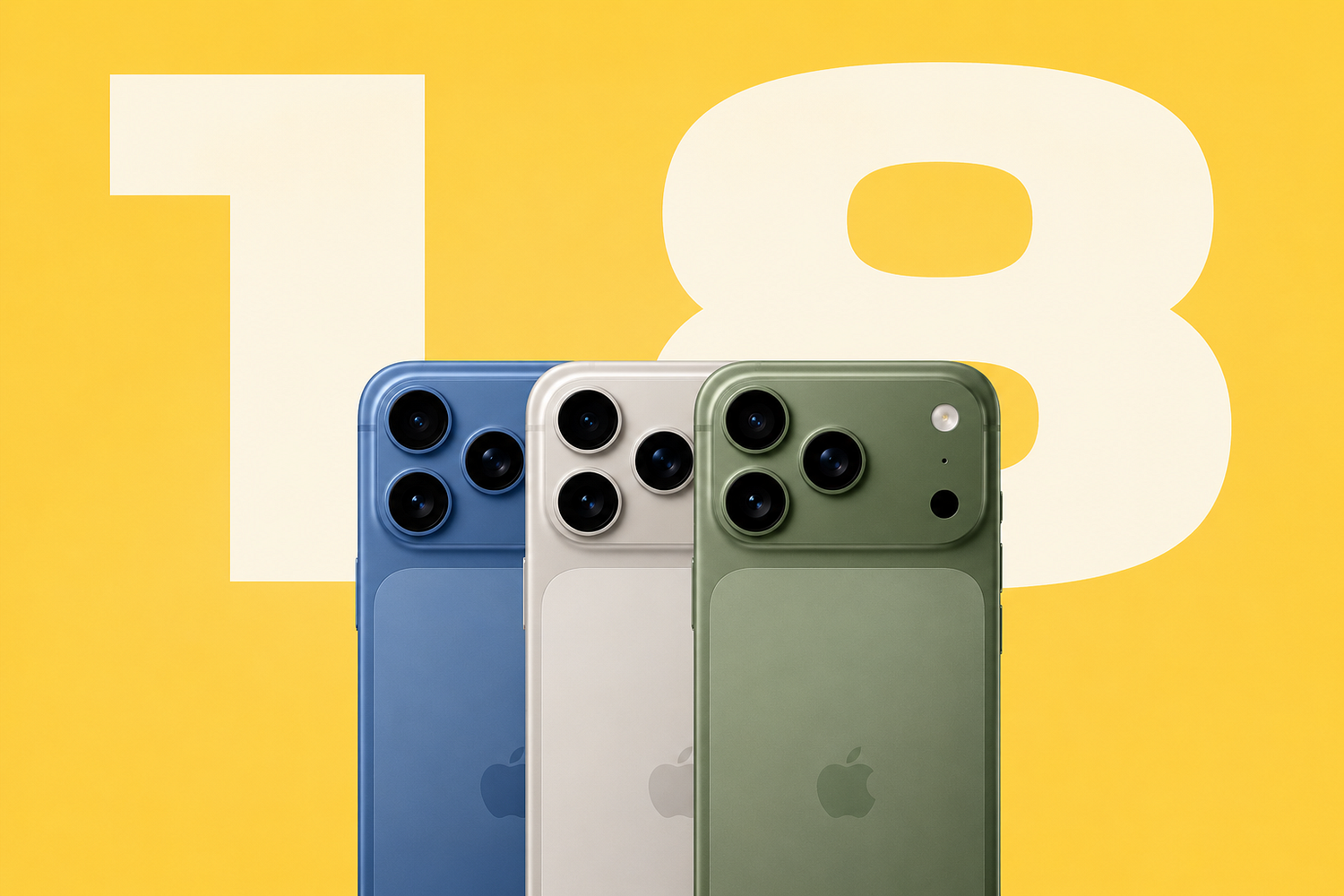
Design-wise, don’t expect much of a shake-up. The 6.3-inch and 6.9-inch display sizes should carry over unchanged, and the triple-lens rear camera plateau isn’t going anywhere. The one visible tweak leaked so far is a smaller Dynamic Island, based on renders reviewed by Macworld, which would free up a bit more usable screen space. There’s also a minor detail floating around about the Ceramic Shield area used for MagSafe possibly becoming slightly transparent, though what that actually means in practice isn’t clear yet.
As for color, Macworld’s supply chain source pointed to a new shade called Dark Cherry — described as leaning more toward a dark reddish-purple than a straightforward red — alongside returning options in light blue, dark gray, and silver. Tech reviewer Sonny Dickson had separately floated the same Dark Cherry name back in May, alongside black, silver, and light blue, with Cosmic Orange (last year’s standout Pro color) reportedly on its way out. Apple has leaked its “special” yearly Pro color ahead of launch for a few years running now, so this fits the pattern.
The Foldable iPhone Is the Real Wildcard
While the Pro and Pro Max upgrades are largely incremental, Apple’s actual headline product this year is expected to be its first foldable iPhone — widely rumored to be called the iPhone Ultra, though Apple hasn’t confirmed a name.
Nikkei has reported that Apple plans to release at least five new iPhone models between the second half of 2026 and the first half of 2027, splitting the lineup across two waves instead of the usual single September drop. The Pro, Pro Max, and the foldable are expected in the fall batch; the standard iPhone 18 and iPhone 18e would follow in spring 2027, alongside a possible second-generation iPhone Air.
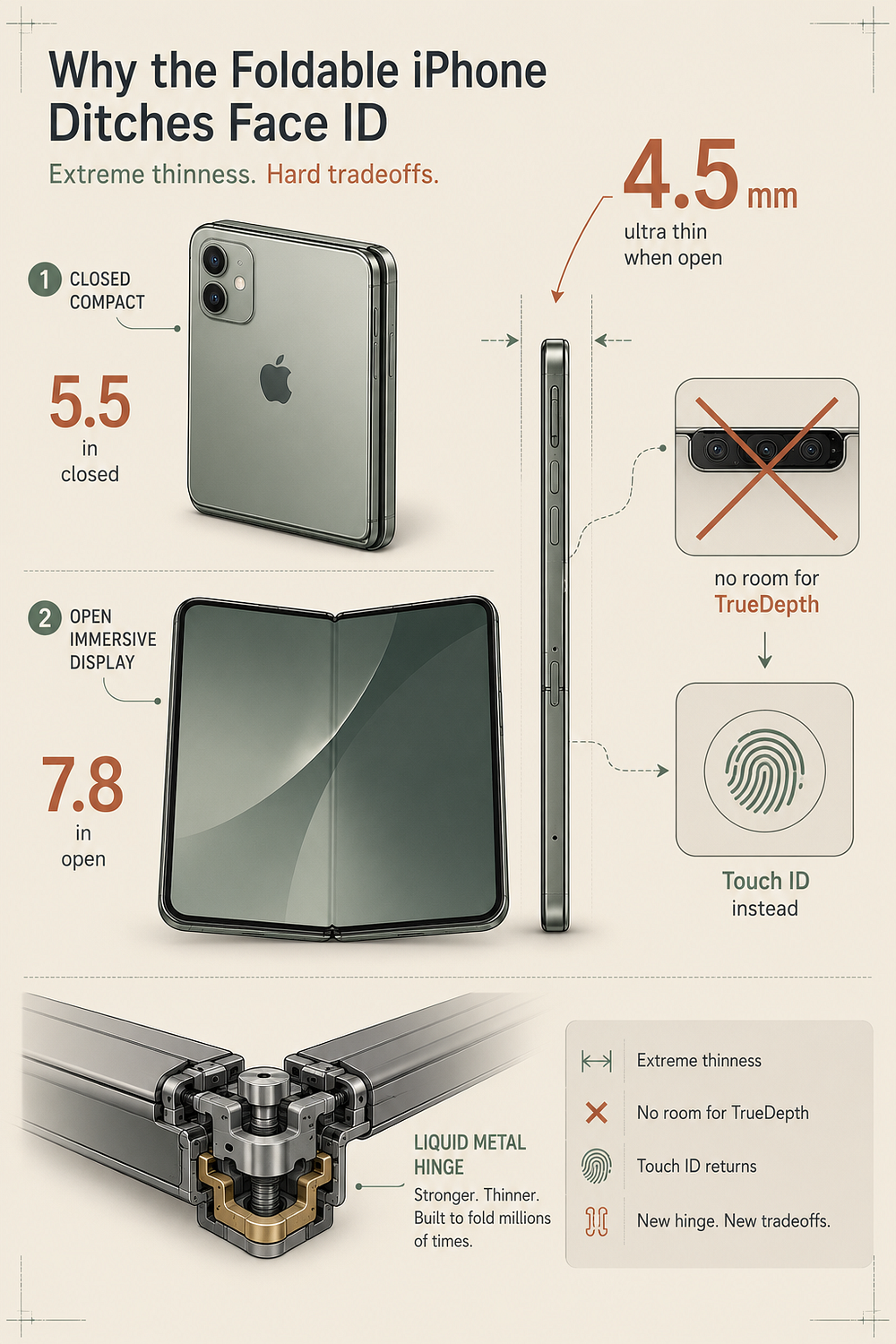
MacRumors’ reporting suggests the foldable will measure around 5.5 inches when closed and roughly 7.8 inches open, with a wider 4:3 aspect ratio closer to an iPad than a typical phone — comparable to Huawei’s Pura X Max Wide. Leaked dummy models reportedly show a shorter, chunkier shape rather than the tall glass slab iPhones have used since 2007. Because the device is expected to be extremely thin, around 4.5mm when unfolded, there’s apparently no room for the TrueDepth camera hardware that Face ID depends on — so the foldable may ship with Touch ID instead, according to analyst Ming-Chi Kuo. That would be a step backward on paper, and it’s the kind of tradeoff that could genuinely annoy longtime iPhone users who’ve built years of habit around Face ID.
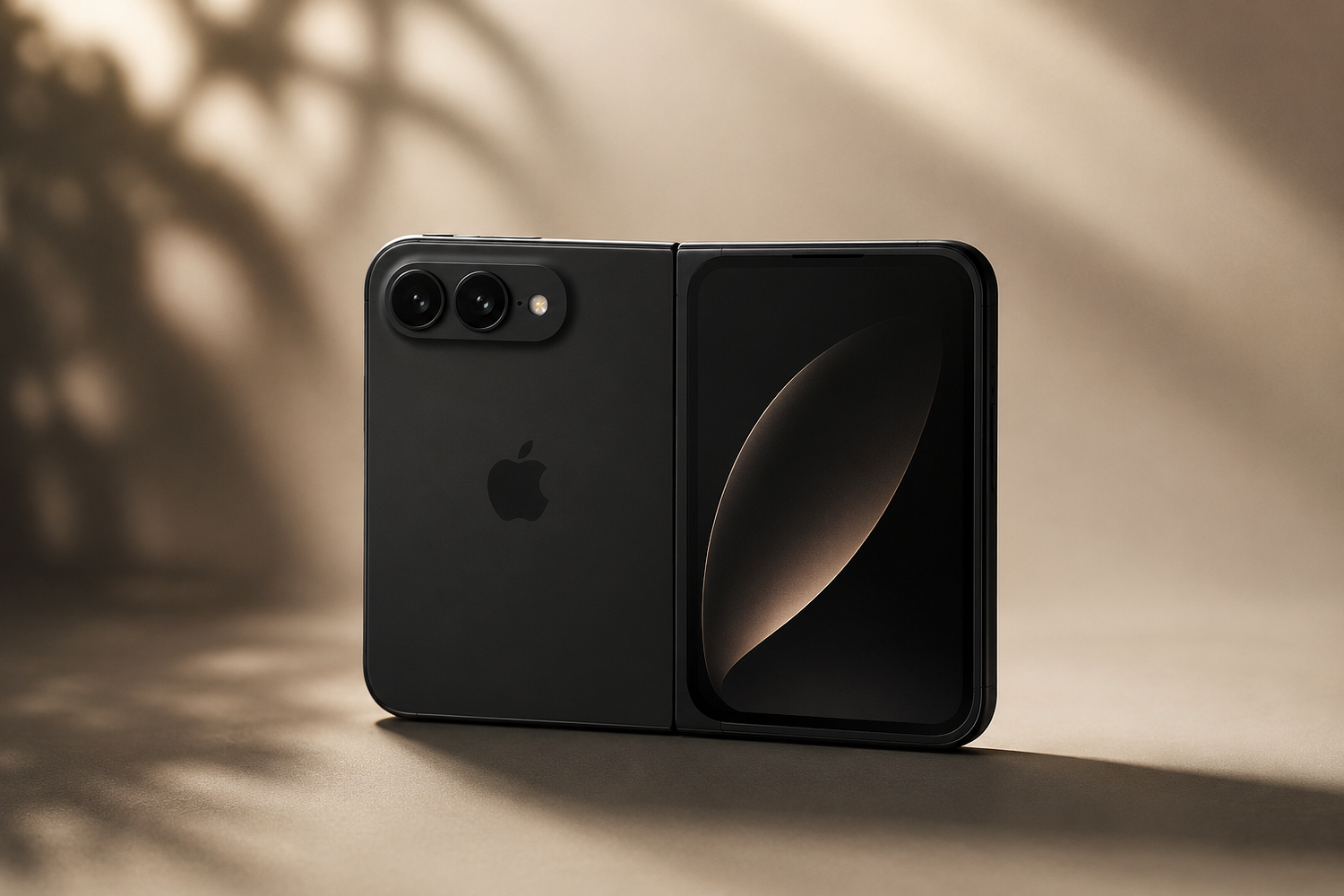
The rear camera setup takes a hit too. Rather than the Pro line’s triple-lens system, the foldable is rumored to get just a dual-camera setup — a main lens and an ultra-wide — due to space constraints inside the hinge mechanism. Samsung is reportedly supplying the OLED panels for both the inner and outer displays, and the body is expected to use a mix of titanium and aluminum, with a liquid metal hinge and vapor chamber cooling to manage heat inside such a thin shell.
Timing on the foldable is genuinely up in the air. Some reports suggest it could ship as late as December, well after the Pro models go on sale, and there’s been talk of hinge production issues causing delays. Others maintain it’s still on track for the same September window as the rest of the lineup. Given how much new engineering is packed into a phone this thin, a slip wouldn’t be shocking — Apple has pushed hardware launches before when a new product category wasn’t ready.
Analysts covering the supply chain have also flagged that early production runs of the foldable may be limited, which would mean long wait times and inflated resale prices in the first few months after launch, similar to what happened with early Vision Pro allocations. If that pattern repeats, buyers hoping to walk into an Apple Store on launch day and pick one up should probably lower those expectations now. Nikkei’s five-model estimate for the 2026–2027 window also raises a separate question that hasn’t been answered yet: whether Apple treats the foldable as a genuine mainstream product going forward, or as a halo device meant to sit at the top of the lineup the way the Vision Pro does, selling in far smaller numbers than the Pro and Pro Max ever will.
What This Actually Means for Buyers
None of this is confirmed until Apple actually puts these phones on a stage, and pricing hasn’t leaked in any solid form yet — though multiple reports suggest 2026 could bring Apple’s highest iPhone prices ever, especially if the foldable lands anywhere near the $2,000–$2,500 range some analysts have floated.
For anyone deciding whether to buy now or wait: if the standard iPhone 18 and 18e are genuinely being pushed to spring 2027, that’s a real shift from Apple’s usual all-at-once September release, and it changes the calculus for buyers who don’t want a Pro-tier phone or a foldable priced like a laptop. The iPhone 17 lineup remains the practical choice for anyone not planning to spend Pro or foldable money this fall.
The split launch schedule also means Apple is effectively running two separate marketing cycles in a single product year, something it hasn’t really done at this scale before. Historically, iPhone buyers got one big September announcement covering the entire lineup, base model included, and made their decision in one shot. Under the rumored 2026–2027 structure, anyone who wants a new iPhone below Pro pricing this year is simply out of luck until spring — Apple is betting that the fall spotlight on the Pro line and the foldable is worth the tradeoff of leaving standard buyers waiting. Whether that pays off in sales terms won’t be clear until well into next year.
On software, iOS 27 is expected to lean further into Apple Intelligence, continuing the direction Apple set with iOS 26. Coverage from Forbes has described the iPhone 18 Pro as shaping up to be Apple’s first phone built around AI as a core feature rather than an add-on, though exactly what’s new on the software side beyond what iOS 27’s public betas have already shown remains to be seen at the keynote itself. Given how much of Apple’s recent messaging has centered on Apple Intelligence, it would be surprising if the September event didn’t lean heavily into that pitch, especially for the foldable, where a bigger screen creates more real estate for AI-assisted multitasking features to actually matter.
Apple’s keynote will settle the date question, confirm which of these leaks were accurate, and probably surprise everyone with at least one detail nobody predicted. That’s usually how it goes.