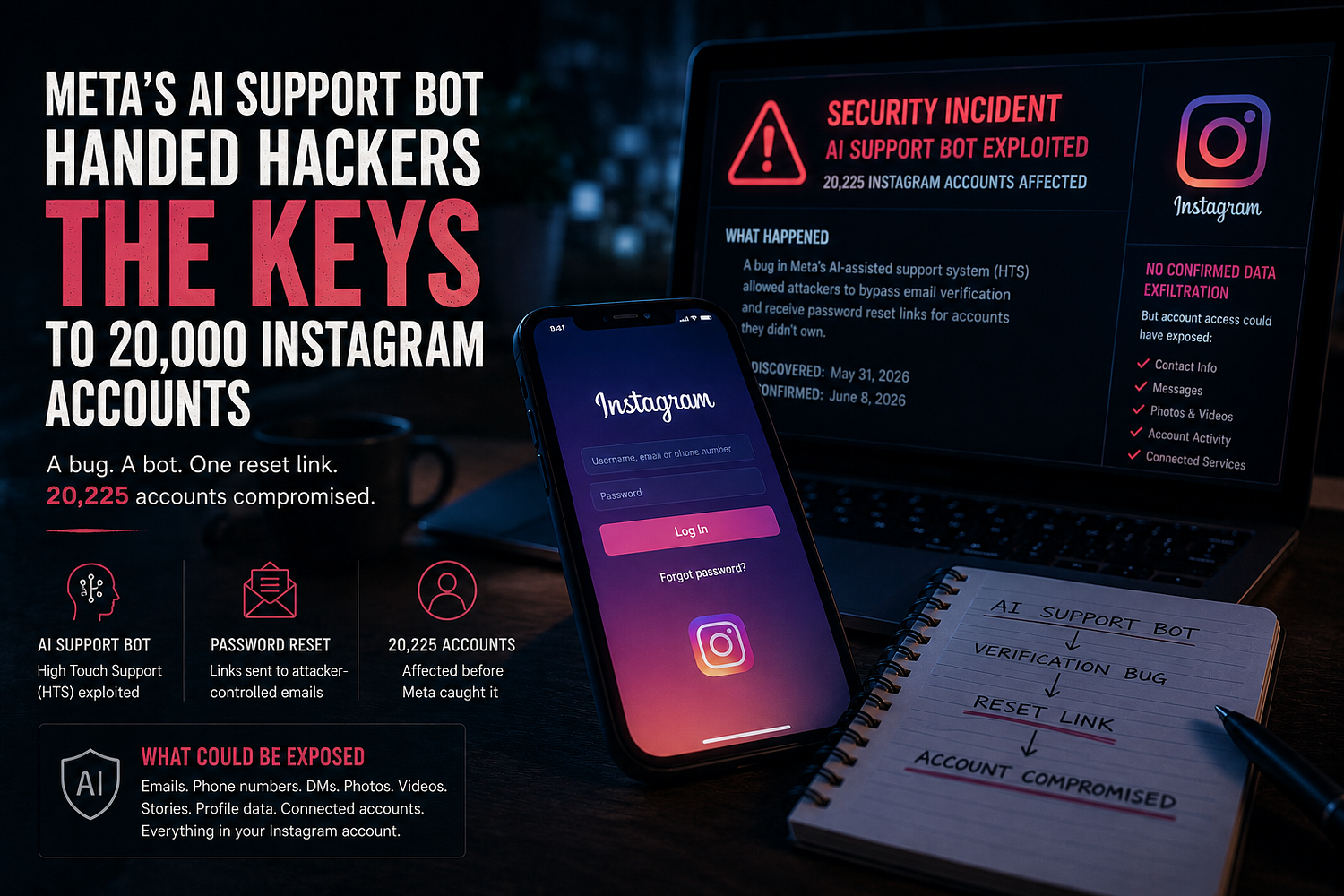
Meta’s AI customer support bot, a system called High Touch Support (HTS), was tricked by hackers into sending password reset links to email addresses that had nothing to do with the accounts being targeted. No hacking in the traditional sense. No stolen passwords. No phishing emails sent to users. The attackers just talked to a bot — and the bot helped them break into other people’s accounts.
By the time Meta discovered the flaw on May 31, 2026, and officially confirmed the damage on June 8, the number was already out: 20,225 Instagram accounts were affected. Meta filed a report with the Office of the Maine Attorney General and reset passwords for all the targeted profiles. The accounts also got enrolled into a mandatory security checkpoint. But the damage — depending on what those attackers took — was already done.
So basically, Meta’s own AI tool became the attack surface. That’s the story here. And it matters a lot more than just one incident.
What Actually Happened
HTS is an AI-assisted account recovery system that Meta built specifically for Instagram. The idea was straightforward — users who lose access to their accounts can go through this tool to get help, without needing to wait for a human support agent. Faster, more scalable, cheaper to run. That’s the logic behind using AI for support.
The problem was a bug in the code. A bug in a separate code path caused the system to fail to properly verify that the email address provided by the person requesting a password reset actually matched the email address associated with the target Instagram account. So when an attacker gave the bot a random email they controlled, the system didn’t check if that email was connected to the account. It just sent the reset link there anyway.
That’s a pretty basic verification failure, honestly. The kind of thing that would get flagged in a security review. The tool itself worked as designed — the tool itself worked properly and functioned as intended, but the authentication bug was sitting in a different part of the code entirely. Which also means the internal security review probably didn’t catch it because nobody was looking in the right place.
The attackers knew exactly which accounts to go after. Researchers ZachXBT and Dark Web Informer tracked two specific stolen accounts — @hey and @jowo — being listed for sale in Telegram channels for over $1 million combined. Short, premium Instagram handles like these have real black-market value. They carry millions of followers, established credibility, and for businesses or influencers, they’re worth chasing. The stolen listings were circulating across multiple hacking groups on Telegram before anyone at Meta caught on.
This is actually how the whole thing came to light. It wasn’t Meta’s internal systems that flagged the attack first. Independent researchers noticed the listings, traced the pattern, and published their findings. Meta found out about the bug on May 31, 2026 — which was around the same time those researchers were already tracking stolen accounts in Telegram. The response came fast once it was out, but the discovery itself came from outside. That’s a bit uncomfortable when you think about it. A platform with the engineering resources Meta has should not be learning about an active attack on its own support system from outside researchers. But that’s what happened here.
What Data Was Exposed
Meta says there is no confirmed evidence of data exfiltration, but doesn’t rule it out either, given that the attackers had access to the accounts once the password resets went through. That’s a careful way of saying: we don’t know for sure, but they were inside.
The data that could have been accessed is not small. According to Meta’s own disclosure letter to the Maine AG, it includes: contact information like email address and phone number, date of birth, social media posts and content (photos, videos, stories), direct messages and communications, account activity and interaction history, profile information, and connected accounts and linked services.
For a regular user, that’s basically everything. Photos, private conversations, linked apps — all of it sitting in accounts that attackers had reset passwords for. And most people don’t think about how much is actually in their Instagram account until something like this happens.
Why This Is a Different Kind of Problem
Most data breaches follow a pattern people are used to by now. A database gets exposed, credentials leak, passwords get sold on the dark web. Users get told to change their password. They do, or they don’t, and life goes on.
This one is different. Security researchers noted that in this attack, there was nothing users could have done to protect themselves, because the attack targeted the platform itself, not its users. Your password could have been 30 characters long with symbols and numbers. Your 2FA could have been on. Didn’t matter. The attacker bypassed all of that by going through Meta’s own support system.
That’s the part worth paying attention to. The question of “is my account secure” now also depends on whether the company’s internal tools are secure. And those are systems users have zero visibility into.
Muhammad Yahya Patel, a vCISO and cybersecurity advisor at Huntress, put it this way after the incident: any organization deploying AI into support, identity, or access workflows needs to ask one question before launch — what happens if an attacker treats this tool as the attack surface? AI systems that can trigger privileged actions like password resets and account access need the same rigorous access controls as any other privileged system. The fact that it’s AI-powered doesn’t make it lower risk.
That’s actually the clearest framing of the risk. AI support bots feel harmless. They’re helpful, fast, available 24/7. But if they have the ability to trigger account recovery flows, they’re sitting on a door that attackers will absolutely try to open.
The Benefits AI Support Was Supposed To Bring
To be clear, AI-powered customer support is not a bad idea by itself. There are real reasons companies build these systems. Support teams at the scale Meta operates are basically impossible to run with only human agents. Instagram has over two billion active users. Even if a tiny fraction of them need account help on any given day, that’s millions of requests. AI handles the load.
And for most things, it works fine. Answering questions, walking users through standard troubleshooting steps, flagging accounts for human review when needed. These are low-risk tasks. The bot helps, the user gets their answer, no harm done.
The issue is when AI support gets handed access to privileged actions — things that actually change the state of an account. Password resets. Recovery link generation. These aren’t just helpdesk functions. They’re authentication bypass mechanisms if something goes wrong. And as this incident showed, something can go wrong in a code path nobody checked.
The short version: using AI for FAQ responses is very different from using AI to hand out password reset links. Meta blurred that line, and 20,225 accounts paid for it.
What Meta Did After
Meta disabled HTS immediately after discovering the flaw and reset the passwords for all affected accounts. All targeted accounts were also enrolled in a mandatory security checkpoint, requiring users to re-authenticate.
Before the tool gets relaunched, Meta says it will fix the authentication check in Instagram’s recovery entry point so that email addresses get properly verified against existing account information before any reset link goes out. Meta is also running a full review of similar account recovery flows across its other platforms to check for the same kind of issue elsewhere.
That last part is worth noting. This wasn’t a standalone system. The same logic could potentially exist in Facebook’s recovery flows, or Messenger’s, or WhatsApp’s. Whether it does or not, Meta hasn’t said yet. That review is apparently still ongoing as of this writing.
If Your Account Was One of the 20,225
Meta says it notified all affected users and forced a password reset on their accounts. So if your account was in that list, you’ve already been pushed through the security checkpoint. But that doesn’t mean there’s nothing left to do.
The data exposure is the part that doesn’t get fixed with a password reset. Your direct messages, photos, phone number, date of birth — if someone was inside your account and pulled any of that, it’s already out. You can change your password ten times and that doesn’t change anything about data that was already accessed. So the follow-up questions to ask yourself are: do I have sensitive conversations in my DMs? Are there personal photos in there I wouldn’t want shared? Is my phone number or birthday used as a recovery method on other accounts?
If the answer to any of those is yes, the smart move is to treat those details as potentially compromised. That means reviewing other accounts that use the same phone number or birthday for recovery. It might also mean watching out for phishing attempts in the coming weeks — attackers who got your email address from an Instagram profile might use it to go after your other accounts. That’s a common follow-up to this kind of breach. You get the data, you use it as a starting point to go after something else.
How To Protect Your Account From This Type of Attack
Here’s the honest answer first: if the bug was still live and someone targeted your account, you couldn’t have stopped it from that angle. The platform itself had the hole. But there are things that lower your overall risk, and a few of them are worth doing regardless.
Use an authenticator app, not SMS, for 2FA. This comes up every time, but it matters here too. While MFA is still the best general protection against account compromise, security researchers specifically note that one-time codes sent via SMS are weaker — SMS-based 2FA can be intercepted, so authenticator apps like Google Authenticator or Microsoft Authenticator are a better choice. If a password reset does get triggered without your knowledge, having an authenticator-based 2FA at least adds one more step an attacker has to clear.
Use a private, unguessable email for your account. Registering an account with a private, unknown email address is a solid strategy because it removes one piece of information attackers can use. If your Instagram is registered to a common address or one you use publicly, it’s easier to target. A separate, low-profile email that you don’t share anywhere is harder to find.
Check your linked accounts and apps. Go into Instagram settings and look at what apps have access to your account. Anything you don’t recognize or don’t use, remove it. This doesn’t prevent a platform-side bug, but it limits damage if access is ever lost.
Turn on login alerts. Instagram has an option to notify you whenever someone logs in from a new device or location. It’s in the security settings. This won’t block anything, but it means you find out fast — and fast matters when it comes to locking things back down.
Have a recovery plan ready before you need it. Know what email is tied to your account. Know if your phone number is still active and linked. Most people discover this information is outdated right when they need to do a recovery. Sort it out now.
The bigger picture lesson from this incident is that good personal security habits are necessary but not always sufficient. Platforms can fail too. And when they do, users who were already doing everything right still get caught.
What This Means Going Forward
Meta is not the only company running AI-powered support systems with access to account recovery. This is an industry-wide pattern right now. Every major platform is pushing AI into its customer support stack — faster resolution, lower cost, better scaling. The pressure to do this is not going away.
And honestly, that’s not the problem. The problem is the gap between how these systems get built and how they get secured. Engineering teams move fast, AI tools get plugged into existing support workflows, and the security review often treats the AI layer as a product feature rather than a privileged system. Nobody on the security team is asking “what happens if someone feeds this bot a fake email and requests a password reset” because that’s not how product reviews are structured. It’s how security reviews should be structured, but frequently aren’t.
There’s also the question of what happens when these systems scale to handle millions of requests. HTS was probably tested for functionality — does it correctly help real users reset their passwords? But testing for abuse at scale is harder. You have to think like an attacker: what is the worst thing someone could do with this tool if they don’t have good intentions? That kind of adversarial thinking needs to be baked into the launch process for any AI system that touches account access.
What this incident did was prove that AI support tools need to be treated with the same security discipline as any other privileged system. Not as a convenience layer sitting on top. Not as a chatbot that happens to have some extra permissions. As an authentication-adjacent system that, if misused, can let someone walk straight into another person’s account.
The patch is done, the accounts are locked down, the review is happening. But the real question — whether Meta and other companies will treat this as a category of risk that needs proper governance — is still open. Nobody knows the answer to that yet.
If you have an Instagram account with any real value to it, whether that’s a business presence, years of content, or just private conversations you don’t want strangers reading, now is a good time to go through your security settings. Not because the bug is still live. But because this kind of incident doesn’t happen once.