So it actually happened. On April 10, 2026, the Dutch vehicle authority RDW approved Tesla’s Full Self-Driving (Supervised) system for use on public roads in the Netherlands. This is the first time FSD has been legally cleared for real roads anywhere in the EU. Not a test program. Not a closed track demo. Actual approval, with a subscription price already listed on Tesla’s Dutch website — €99 per month, or €7,500 if you want to buy it outright.
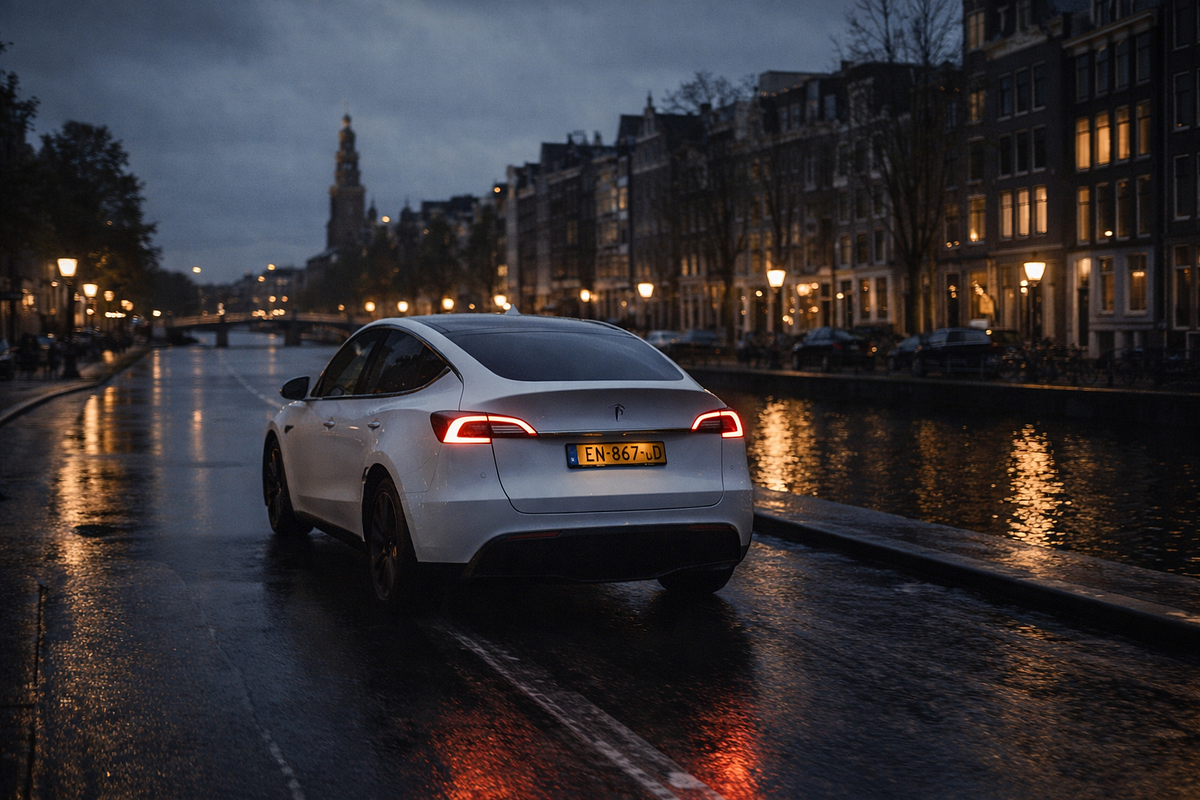
I’ve been following this for a while now. Tesla owners in Europe have been stuck on a basic version of Autopilot for years while their American counterparts kept getting FSD updates end-to-end neural networks, automatic lane changes, city street navigation, the whole thing. Every few months someone on a Tesla forum would ask “when is FSD coming to Europe?” and the answer was always some version of “the regulations are complicated.” So yes, this feels like a big deal. But there’s also a lot of marketing noise around this announcement that’s worth cutting through.
Let me explain what actually got approved, which countries are coming next, and what European Tesla owners can realistically expect.
What the RDW Actually Approved (And What They Didn’t)
The RDW approved FSD version 14.2.2.5 that’s the European-specific build, not the same code running in North America. The RDW’s own statement says the US and EU versions are “not comparable one-to-one,” which is a polite way of saying Tesla had to build a different software stack to satisfy EU rules. The testing ran for 18 months, covered more than 1.6 million kilometers on EU roads, and included over 13,000 customer ride-alongs and 4,500 track scenarios. That’s not a small effort.
What the system can do in the Netherlands: take your hands off the steering wheel during appropriate conditions, make lane changes, navigate to your destination, handle left and right turns, start from a parked position. The eye-tracking camera watches you the whole time. Look away too long and it beeps at you, then vibrates, then disables FSD and hands control back. If you still don’t respond, it’s designed to bring the car to a stop. Also, before you can even activate it, Tesla is making Dutch owners take a quiz to confirm they understand “Supervised” means they are still responsible. That part I actually like — the complacency risk with advanced Level 2 systems is real.
What this is NOT: the system is not autonomous. The RDW statement is very clear — the driver is legally responsible at all times. The word “Supervised” is doing a lot of work here. Honestly, Tesla’s tweet that said “no other vehicle can do this” was a bit much, because the RDW’s own documentation points out that BMW already holds approval for motorway hands-off driving with lane changes, and Ford has BlueCruise approved in Europe via Article 39. Tesla’s system is arguably more capable in city environments, but the “no other vehicle” claim is misleading.
The Rollout Going Forward — Netherlands Is Just the Start
Here’s the regulatory part that matters for everyone else in Europe. The RDW’s approval is technically described as a “European type approval with provisional validity in the Netherlands.” That phrase is important. It means other EU countries can recognize this approval at the national level without Tesla having to redo the entire 18-month process from scratch. Germany, France, Italy, Belgium, and Spain are reportedly next — Tesla expects recognitions within four to eight weeks of the April 10 Dutch approval.
Full EU-wide coverage, where the approval applies simultaneously across all 27 member states, needs a formal European Commission vote. That’s estimated at two to four months. Tesla’s public statements say summer 2026 for EU-wide availability. The European Commission has not committed to that timeline, and to be fair, the UNECE framework that underpins this whole approval hasn’t even officially entered force yet — that vote is expected in June 2026. So “summer 2026 for all of Europe” is Tesla’s projection, not a confirmed regulatory outcome. Could slip.
The rollout in the Netherlands itself started with early testers on AI4 hardware — that’s the latest Hardware 4 computer. Older AI3 (HW3) vehicles haven’t gotten it yet. Tesla has hinted that HW3 support is possible later, probably with a different version of the software, but nothing confirmed. If you have a Model 3 or Y from 2021 or 2022, you might be waiting longer than people with newer hardware.
Why This Took So Long — And Why It Matters Financially
European regulation is fundamentally different from the US system. In America, Tesla can push FSD updates over the air without prior regulatory approval. The system is “self-certified” and monitored after deployment. Europe requires type approval before anything goes on public roads — meaning regulators actually have to evaluate the system first, document the compliance requirements, run the tests. It’s slower but that’s how it works here.
The other thing is the UNECE framework situation. As EVXL reported back in February, the updated autonomous driving framework that replaced old prescriptive hardware requirements with a “Safety Case” approach was approved in draft in January 2026. Without that change, the RDW would have had no clean legal way to approve a neural network-based vision system — the old rules were written for deterministic sensor-fusion systems with lidar and radar, not a camera-only AI. The regulatory path literally didn’t exist until recently. Tesla’s timing, getting this approval in April, makes more sense when you understand that context.
Financially, this is a big deal for Tesla. Their European sales dropped 27.8% in 2025 — a combination of more competition from Chinese EVs, price cuts squeezing margins, and, let’s be direct about it, the political visibility of Elon Musk making some European buyers uncomfortable. FSD subscriptions at €99/month are one of Tesla’s highest-margin revenue lines. Europe has a huge existing Tesla fleet that has never paid anything for FSD. Getting even a fraction of those owners to subscribe is meaningful money. Also, Musk’s 2025 compensation package apparently includes a milestone requiring 10 million active FSD subscriptions globally. They hit one million in Q4 2025. Europe suddenly becomes very relevant to whether that target gets reached.
What’s Different About the European Version
A few things stood out to me when I started going through the details. The European FSD build has some UI elements and safety indicators you don’t see in the US version — specific visual cues, different alert sequences, stuff baked in to satisfy RDW’s requirements. The eye-tracking monitoring is stricter than what North American drivers deal with.
The v14.3 build running in North America and the v14.2.2.5 build going out to Dutch customers are different versions. American owners have been testing end-to-end neural networks since about late 2023. European owners are starting from scratch with FSD, going directly to the v14 architecture, skipping the whole evolution of earlier FSD versions. So in a weird way, Dutch Tesla owners are getting a more polished version as their starting point, without having lived through the years of bugs and weird behavior that American owners dealt with. That’s probably fine.
The European roads present different challenges too. Amsterdam’s street layouts, roundabouts, narrow lanes with cyclists everywhere — that’s harder driving than a lot of American suburbs where FSD was mostly trained. Tesla pushed FSD out to Dutch early testers the day after RDW approval, April 11, which means they had the software ready and waiting. It wasn’t shipped because of regulatory uncertainty.
The Complacency Issue Nobody Wants to Talk About
I want to spend a minute on this because I think it gets glossed over in most coverage. Advanced Level 2 systems have a documented problem — they work well enough that drivers stop paying attention, which is exactly the opposite of what “Supervised” means. The better FSD gets, the harder it is to stay alert. Your brain is not designed to supervise a system that almost never needs you. Studies have shown this happens with other Level 2 systems too, not just Tesla.
The RDW was explicit about this risk. Their statement says drivers must be able to intervene “immediately at all times” — not “soon” or “when necessary” but immediately. The quiz requirement before first activation is one approach to making sure people understand this. Whether it actually helps people stay attentive after the hundredth trip is a different question. This part still doesn’t fully make sense to me — how do you keep a driver genuinely alert in a car that’s doing everything correctly for months? Tesla and regulators haven’t answered that convincingly yet.
And yeah, Waymo is in the background of all this. Waymo’s robotaxis in San Francisco and Phoenix, and their upcoming London launch, are fully driverless — Level 4, no human needed. Tesla’s system still requires you to watch the road. From a consumer perspective, “hands off the wheel but eyes on the road” is genuinely useful. From a technology perspective, the gap between Level 2 and Level 4 is enormous. Tesla’s marketing leans into closing that gap rhetorically, but the regulatory paperwork tells you exactly what it is.
What to Actually Expect If You Own a Tesla in Europe
If you’re in the Netherlands right now with an AI4 vehicle, you either already got the 2026.3.6 update or you’re in the queue. It’s rolling out in waves. Demo drives are available through Tesla’s Netherlands website if you want to try before subscribing. The €99/month price is genuinely lower than the US subscription cost at current exchange rates, which is a bit surprising.
If you’re in Germany, France, Italy, Spain, or Belgium — the next few weeks matter. If those national recognitions come through on Tesla’s four-to-eight-week timeline, you could have FSD by June. If the process slows down or any country asks for additional review, it could push to the summer or later. There’s a tracking site, fsdtracker.eu, that’s been updating in near real-time as countries process their approvals. Worth bookmarking.
If you’re on older hardware in any of these countries — honestly, just wait. No confirmed timeline for HW3 support in Europe. Tesla has a history of making promises about hardware compatibility that take longer than expected. I’d want to see it actually happen before making any financial decisions around it.
The bottom line is this: April 10 was a real milestone, not just a press release. Eighteen months of actual testing, a legitimate regulatory authority signing off, a working product pushing to customer cars the next day. That’s not vaporware. But it’s also a driver assistance system, not a self-driving car, and the gap between those two things is still large.
Europe is getting FSD — just make sure you know which FSD you’re actually getting.