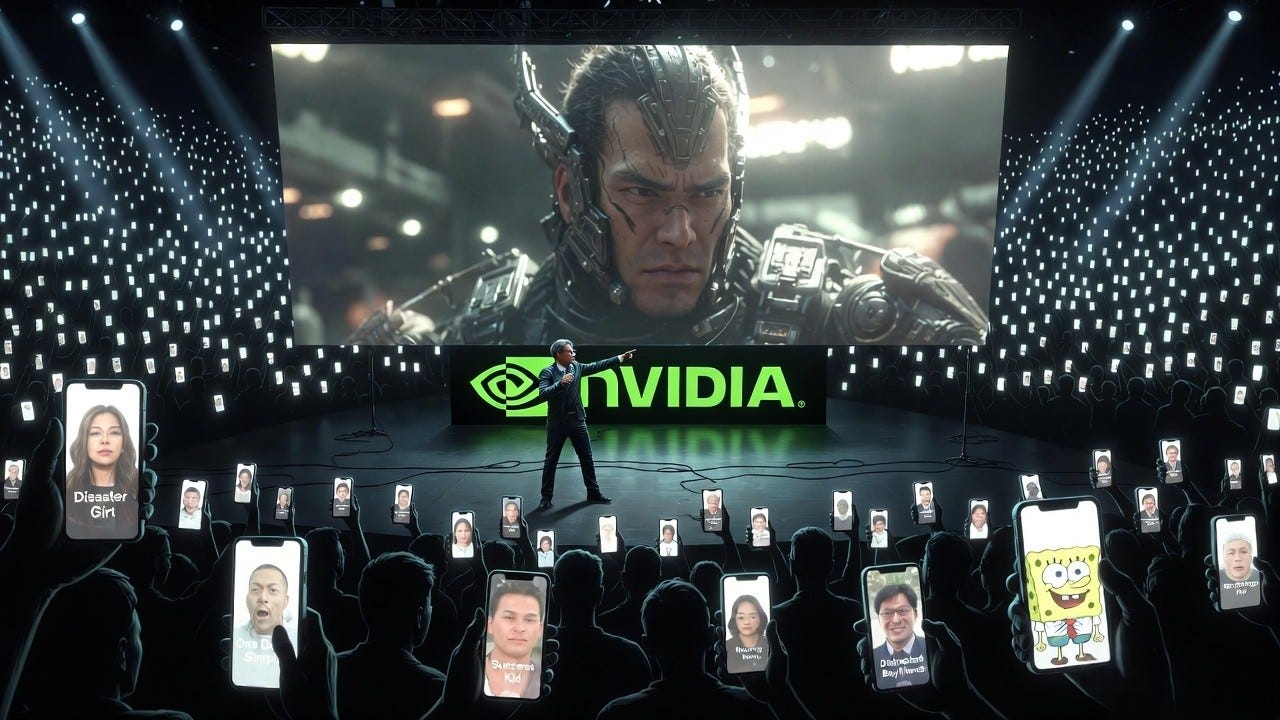
March 2026. Jensen Huang walks onto the GTC stage wearing his signature leather jacket, confident as ever. He holds up DLSS 5 like a trophy and delivers the line that would haunt NVIDIA’s PR team for weeks:
“DLSS 5 is the GPT moment for graphics.”
The crowd inside applauded. The internet outside erupted — but not in the way NVIDIA had planned.
Within hours, DLSS 5 was being called a beauty filter. A yassification machine. A technology that takes carefully designed game characters and smooths them into something that looks less like art and more like an Instagram influencer after three rounds of FaceApp.
The memes spread faster than NVIDIA’s press release. People made memes of Kratos. They made memes of Grace Ashcroft from Resident Evil. Weird transitions, funny comparisons, side-by-side screenshots flooded every gaming forum. Reddit threads pulled thousands of upvotes. The comment sections were unanimous: “What have you given us? The originality of the game is gone.”
And the darkest irony of all? Gamers spent years screaming for realistic graphics. They wanted photorealism. They demanded better lighting, better skin, better materials. And now that NVIDIA delivered exactly that — they turned around and said: “What have you done, brother?”
Then Jensen Huang made everything worse.
When asked about the backlash at a press Q&A, he did not pause. He did not acknowledge the concern. He said simply:
“Well, first of all, they are completely wrong.”
Two words. And just like that, what started as a technology debate became something far more personal.
This article is not here to tell you whether DLSS 5 is good or bad technology. Honestly, it is probably impressive. This article is here to explain why the backlash is legitimate, why Huang’s response made everything worse, and what this moment reveals about the uneasy relationship between AI and gaming.
What DLSS 5 Actually Is — And Why It Is Harder Than It Looks
Before the anger and the memes, let us make sure we understand what we are actually talking about. Because a lot of the confusion around DLSS 5 starts here.
DLSS stands for Deep Learning Super Sampling. It has existed since 2018. The original concept was simple: instead of making your GPU render every pixel at full resolution, let an AI fill in the gaps. Run the game at a lower resolution, upscale it intelligently, and achieve better visuals at better frame rates simultaneously. It worked brilliantly. Over 750 games adopted it. It became the gold standard for PC gaming performance.
Then came DLSS 4 and DLSS 4.5 — which introduced AI-generated frames. NVIDIA was claiming 500 frames per second in certain scenarios. People laughed. They said, who actually needs 500 FPS? Nobody asked for this. But the technology kept pushing forward regardless.
DLSS 4.5, released just months before this announcement, went even further. It uses AI to draw 23 out of every 24 pixels you see on screen. Almost everything on your display is being generated by an AI, not rendered by your GPU. The reason nobody rioted about this? Because you could not see it happening. It was invisible. It served the game without changing it.
DLSS 5 is different. And understanding why it is different matters enormously.
It takes each game frame and runs it through an AI model trained to understand complex scene elements at a deep level — skin, cloth, hair, facial expressions, lighting, reflections, materials. The AI then reworks the lighting, reworks the skin, reworks the reflections, and tries to make the result look as close to real life as possible. It does not just fill in missing pixels. It alters existing ones. It changes how characters look. It changes how scenes feel.
And here is what makes this genuinely technically impressive, even if the results are controversial: it is doing all of this in real time. As your game runs, frame by frame, dynamically. Every time your environment changes — every shadow shift, every new lighting condition, every facial expression — the AI is recalculating and re-rendering accordingly. NVIDIA claims real-time performance even at 4K resolution, with no latency. Frame-to-frame consistency maintained.
That is not easy. Do not let the memes fool you into thinking this is simple. This is genuinely one of the most technically ambitious things NVIDIA has ever attempted.
But ambitious does not mean uncontroversial.
The Problem: It Currently Takes Two RTX 5090s to Run It
Here is the part of the announcement that quietly revealed everything.
The DLSS 5 demos shown at GTC? They were running on two RTX 5090 Founders Edition cards simultaneously. One GPU was running the game. The other GPU was dedicated entirely to processing DLSS 5.
Two RTX 5090s. The 5090 alone costs approximately $2,000. So the current state of DLSS 5, as demonstrated to the world, requires approximately $4,000 worth of graphics cards to function.
NVIDIA says that when it fully rolls out, it will run on a single GPU. They promise single-card performance. We will believe that when we see benchmarks on real hardware. But the fact that the showcase required two of their most powerful cards says something important about how far the technology is from being ready for most people.
The overwhelming majority of PC gamers are running RTX 30 Series cards, mid-range laptops, or AMD hardware. They will not see DLSS 5 for years, possibly longer. Yet this technology is being positioned as the future of all gaming graphics and the reinvention of computer graphics for everyone.
Being told the future of your hobby requires hardware most people cannot afford — and then being told you are “completely wrong” for questioning it — produces a specific and understandable frustration.
The Screenshot That Started a War
You want to understand the backlash? Look at one image.
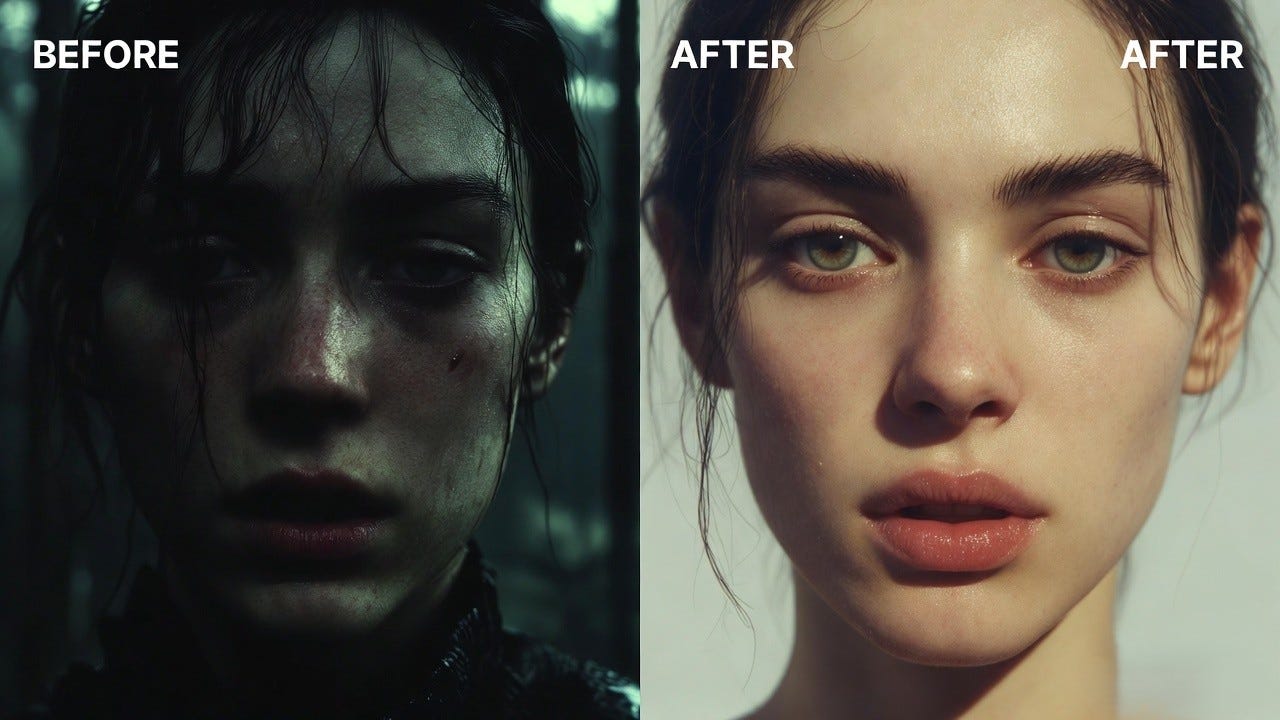
NVIDIA’s comparison screenshot for Resident Evil Requiem shows a character named Grace Ashcroft. Left side: DLSS 5 off. Right side: DLSS 5 on. The difference is immediate and visible. Her skin is smoother. Her features are more symmetrical. Her overall look shifts from a grounded, intentionally designed horror game character into something that looks like it was processed through a beauty app.
Look closely at the details. The skin quality is completely reworked. The lips appear filled. Hair strands are individually lit. The reflection in her eyes is sharper. Even the street behind her and the building in the background show more detail. The car mirror in the background reflects more accurately.
Technically, every one of those changes is an improvement in photorealism.
And that is exactly the problem.
The gaming community had a word for this immediately: yassified. For those unfamiliar, “yassification” is what happens when you apply a beauty filter to its maximum setting — smooth everything, brighten the eyes, reduce imperfections, maximize symmetry. The result looks polished. It also looks like everything else.
But this is not just an aesthetic complaint. It is a deeper one.
Resident Evil is a horror franchise. Horror works because of discomfort. Because of imperfection. Because the human face sits at the edge of reality rather than comfortably inside a beauty standard. The uncanny valley — that unsettling feeling when something almost looks human but not quite — is a tool horror designers use deliberately. A smoother, more symmetrical, more photorealistic Grace Ashcroft is arguably a less scary Grace Ashcroft.
CAPCOM’s artists did not design her to be beautiful by conventional standards. They designed her to feel real and unsettling in a specific way. DLSS 5, by default, decided it knew better.
And then there is the wild thought that many people have been quietly worrying about. What happens when DLSS 5 gets it wrong?
“Imagine that there is a problem in the game — the lighting changes, facial expressions are destroyed, someone is laughing in a crying scene, someone is wearing a leather jacket and it suddenly becomes cotton.”
This is a legitimate technical concern. AI systems, even very good ones, fail in unexpected ways. The image generation tools we use today occasionally produce a prompt result that is completely wrong. ChatGPT occasionally gives a reply that misses the point entirely. DLSS 5 is making real-time decisions about how your game looks, frame by frame, based on AI inference. NVIDIA has presumably considered failure cases. But until the technology is in the hands of players across thousands of different games and hardware configurations, nobody knows exactly how often it will make a frame worse instead of better.
Jensen Huang’s Two Words and Why They Backfired
Here is what Huang should have said when Tom’s Hardware asked him about the backlash:
“These are early demos and the final implementations will look different. We understand that gamers have concerns about artistic intent, and we are fully committed to giving developers the granular control they need to protect their vision. Every game will use DLSS 5 differently.”
That response exists. It addresses the concern. It opens a conversation.
He did not say that.
Instead: “Well, first of all, they are completely wrong.”
And just like that, a technology debate became a community versus corporation moment. The Principal Skinner meme spread rapidly because it described the situation perfectly — a figure insisting the entire audience is wrong rather than asking why they feel that way.
Huang’s technical defense was coherent. DLSS 5 is not a post-processing filter. It operates at the geometry level, grounded in the game’s own 3D assets and motion data. Developers have controls — they can adjust intensity, apply masking, limit where the AI enhancement applies, and color-grade the output. Developers can decide whether they want improvement only in facial details, or applied to the full environment. They can use DLSS 5 fully, partially, or not at all.
NVIDIA says developers have complete control. Whether they want to limit it, use it fully, or apply it selectively — the choice is theirs.
All of that is probably true.
But here is what Huang missed: the gamers were not wrong about what they saw. They were wrong about the technical architecture. Those are two completely different things.
When someone looks at Grace Ashcroft and says “DLSS 5 made her look like she went through a beauty filter,” they are describing what they observed in the screenshot. That observation is accurate. Telling them they are “completely wrong” is not correcting a misunderstanding — it is dismissing a legitimate response to real visual evidence.
“At CAPCOM, we strive to create experiences that feel cinematic, compelling and deeply believable — where every shadow, texture and ray of light is crafted with intention to enhance atmosphere and emotional impact.” — Jun Takeuchi, Executive Producer at CAPCOM
Read that quote carefully. CAPCOM’s own executive is describing a philosophy of intentional craft — every element chosen deliberately to serve the atmosphere. DLSS 5, by default, takes that intentional craft and runs it through an AI trained on a different definition of visual quality. The friction is not imaginary. It is structural.
The Detail Nobody Is Talking About: Developers Found Out When You Did
Here is the part of the DLSS 5 story that received almost no coverage compared to Huang’s quote.
According to reporting from Insider Gaming, developers at Ubisoft and CAPCOM were informed about DLSS 5’s announcement at approximately the same time as the general public. One Ubisoft developer said directly: “We found out at the same time as the public.”
Let that land for a moment.
CAPCOM — the studio whose character became the face of the entire controversy, whose game was used in NVIDIA’s primary comparison screenshots — apparently did not have deep involvement in how that demonstration was framed.
NVIDIA’s press release includes enthusiastic quotes from Jun Takeuchi of CAPCOM and Todd Howard of Bethesda. On paper, the developer support looks solid. But there is a meaningful difference between a studio executive providing a PR quote and a development team genuinely having worked with the technology and signed off on how their characters appear in public comparison screenshots.
If developers are finding out about these announcements the same time as the public, the claim that “developers have full artistic control” is describing a future promise, not a current reality.
This matters because it is the center of the entire debate. Every time the criticism has been “DLSS 5 will change how our games look,” the answer has been “developers control everything.” If developers are not yet fully involved, that answer is hollow.
Four Years of Earning This Reaction
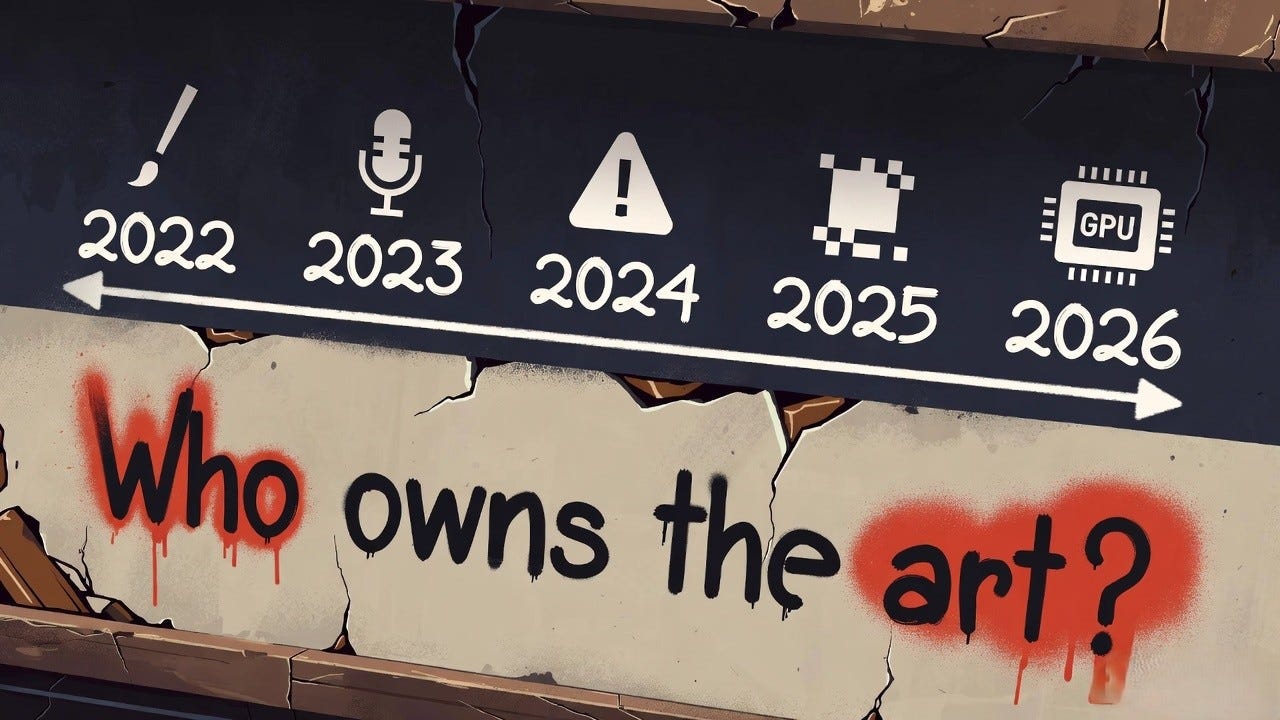
The DLSS 5 controversy did not materialize from nothing. It was built, layer by layer, over four years.
2022 — AI-generated artwork floods social media. Concept artists begin losing work. The alarm is real.
2023 — Hollywood writers strike partly over AI protections. Voice actors fight contracts containing AI cloning clauses. The threat to creative work stops being theoretical.
2024 — Multiple shipped games are found to contain undisclosed AI-generated assets. Studios apologize. The pattern becomes familiar and trust erodes further.
2025 — DLSS 4.5 draws 23 of every 24 pixels using AI. Most players cannot tell. But some begin quietly asking what “real” graphics even means anymore.
2026 — DLSS 5 visibly, demonstrably alters the aesthetic of games in ways you can see in a screenshot. Four years of accumulated suspicion finds a single, highly visible target.
The memes were not just jokes. They were a community expressing something they did not have formal language for — and finding the most effective language available.
The “Artistic Control” Argument and Its Limits
NVIDIA’s consistent defense is that developers have full artistic control. Intensity sliders. Masking options. Target area selection. The ability to apply DLSS 5 to faces only, or environments only, or everywhere at once.
This sounds reassuring. But consider this.
Imagine you hire a talented musician to collaborate on your album. They are extraordinary — technically better than you at certain things. But their entire training was in jazz, and everything they touch instinctively moves toward jazz. You can give them notes. You can ask them to reduce the jazz on a specific track. But their default creative instinct is always jazz. You are not starting from a neutral collaborator. You are asking someone to work against their training.
DLSS 5’s AI was trained on a specific definition of photorealism. When developers “have control,” what they actually have is the ability to reduce or redirect what the AI does by default. That is meaningfully different from starting from a neutral canvas.
The default matters enormously. Because not every developer will have the time, budget, or technical expertise to fight the defaults. Smaller studios — exactly the ones who stand to benefit most from DLSS 5 — are going to use standard settings. And the standard settings, as demonstrated by the launch screenshots, produce a specific aesthetic that will not suit every game.
“The biggest benefit of this is for low-budget gaming studios who have very good stories, very good games, but are not able to develop at a level which gamers like. They can make their games much better using DLSS 5.”
This is a genuinely compelling point. And it is the most underrated argument in favor of DLSS 5. An indie studio with a brilliant concept but limited graphical resources could use DLSS 5 to close the visual gap between their vision and their budget. That is actually exciting. That is a democratizing use of the technology that the controversy has almost completely drowned out.
But that future exists alongside the risks. The same technology that lifts a small studio’s visuals could alter the carefully crafted atmosphere of a AAA horror game if implemented carelessly.
The GPU Strategy Nobody Is Saying Out Loud
Here is a theory worth considering.
GPUs have arguably peaked in terms of raw performance gains. The performance difference between the RTX 4090 and the RTX 5090 is real but not dramatic by historical standards. Frame generation and multi-frame generation added AI-produced frames, but many players openly said they did not care about 500 FPS. The commercial AI segment is already established and lucrative. NVIDIA needed a new story to tell gamers.
Enter DLSS 5.
Right now, DLSS 5 runs exclusively on RTX 50 Series hardware — and as demonstrated, currently needs two 5090s at full capability. But think about what happens when the RTX 60 Series launches.
NVIDIA will be able to say: the 5090 could barely run DLSS 5. The new 6060 runs it effortlessly.
It is the same sales strategy they used when the 5070 was marketed as delivering 4090-level performance. Create a new benchmark that makes older hardware feel inadequate, then sell the next generation as the accessible entry point. DLSS 5 becomes the unique selling point for the 60 Series. The feature that seems too expensive and exclusive today becomes the reason you upgrade tomorrow.
This is not cynicism. This is how GPU generations have always worked. But understanding the strategy helps explain why DLSS 5 was announced now, in this form, with this level of incompleteness.
What Needs to Happen
DLSS 5 launches in the fall. NVIDIA has a genuine opportunity to change this narrative — not through better marketing, but through better transparency.
Show the controls in action. Not a press release describing them. A real developer, with a real game, showing what it looks like to implement DLSS 5 for a horror game versus an open-world RPG. Show the defaults. Show what happens when you fight them. Show the range of what is actually possible.
Address the developer communication problem. If studios are finding out about these announcements at the same time as the public, that needs to change before launch. The “developers have control” argument only holds water if developers are genuinely involved before the screenshots go public.
Be honest about which games it suits. DLSS 5 will be transformative for certain genres. For others, it may be irrelevant or even harmful to the artistic vision. Saying that plainly would build more trust than universal claims about reinventing graphics.
Stop calling people wrong for aesthetic responses. Gamers are not wrong to prefer a specific look. They are not wrong to notice that “more photorealistic” is an aesthetic choice, not an objective improvement. Engaging with that seriously would do more for NVIDIA’s credibility than any comparison screenshot ever could.
The Honest Final Verdict
Jensen Huang has built one of the most consequential technology companies in history. DLSS is genuinely one of the most impressive pieces of software engineering in modern gaming. And yes — achieving real-time neural rendering at 4K, frame after frame, tracking dynamic environments and facial expressions simultaneously, is not easy. It is remarkable engineering regardless of how the screenshots look.
But none of that makes the backlash wrong.
The backlash is about trust — worn down over four years of watching AI enter creative spaces quietly. It is about who controls the look of our games when AI is making real-time decisions about lighting, skin, and expression. It is about a CEO who chose “completely wrong” over a genuine conversation.
Gaming is art. Aesthetic decisions are not technical errors to be corrected. They are choices that deserve to be respected.
DLSS 5 may yet earn its place in gaming history. The technology is ambitious, the engineering is real, and the potential for smaller studios to close the visual gap between their stories and their budgets is genuinely exciting. The fall launch may show us something the GTC demos entirely failed to convey.
But the conversation NVIDIA tried to end with two words is one of the most important conversations gaming is having right now.
It deserves better than “completely wrong.”
And until NVIDIA provides a real answer — one that engages with the concern instead of dismissing it — the memes will keep coming.
Because that is what happens when a community feels unheard.
They find another way to make themselves heard.