There’s a new messaging app dropping on April 17, 2026, and it’s coming directly for WhatsApp’s crown. XChat — built by Elon Musk’s X platform — isn’t a quiet beta rollout or a half-finished experiment. It’s a loud, very deliberate challenge to a company that controls the daily communication habits of 3.3 billion people. That’s not a typo. More than a third of the planet uses WhatsApp. Every. Single. Day.
So the obvious question: is XChat actually going anywhere, or is this another shiny product from the world’s most famous announcement-maker?
The honest answer is: it depends entirely on what you value in a messaging app. And the more you look at both sides, the more interesting — and complicated — that answer becomes. Because XChat has real strengths that deserve serious attention, but it also carries baggage that no amount of encryption can fix. This isn’t a clean story about a scrappy challenger taking on an aging giant. Both apps are flawed. Both have something the other doesn’t. And where you land on this debate says a lot about what you think a messaging app is actually for.
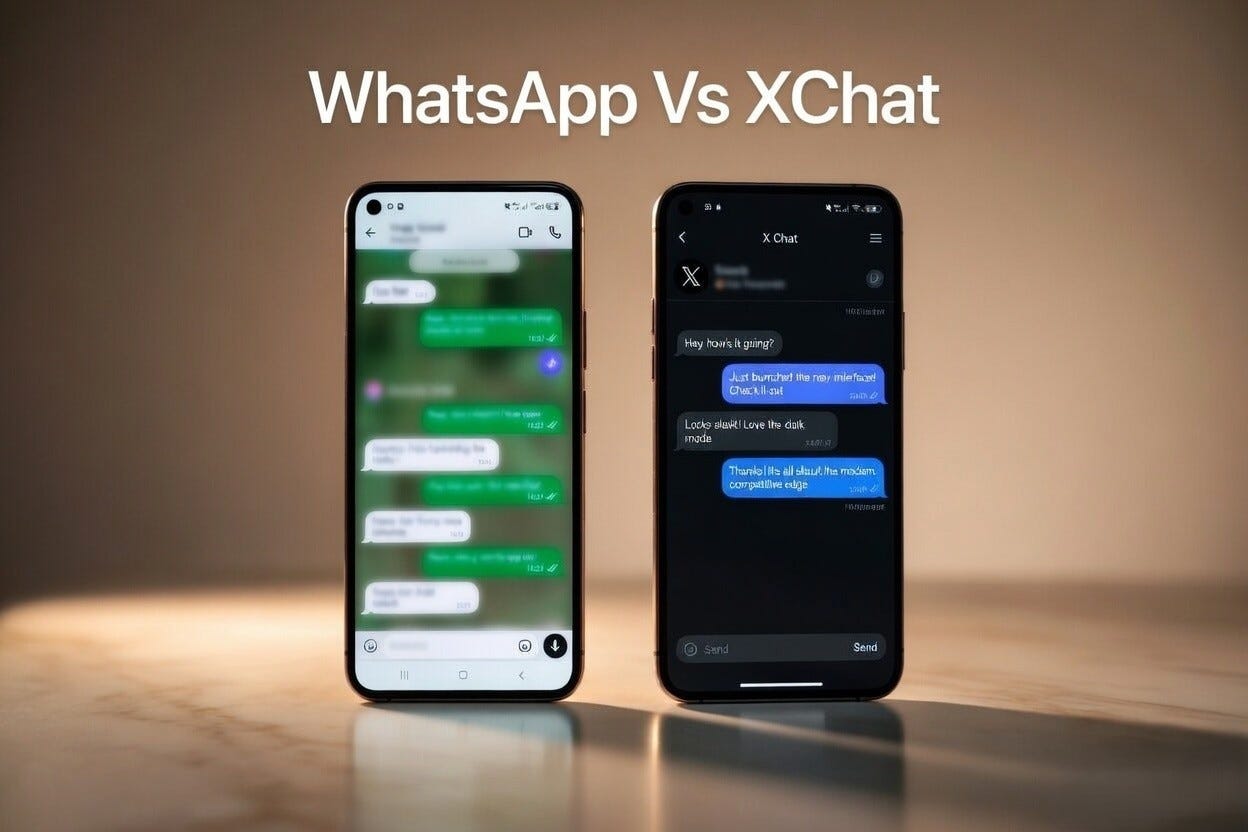
What XChat Actually Is — And Where It Came From
Musk has been talking about building a “Western WeChat” since he acquired Twitter in 2022. Most people dismissed it as fantasy. WeChat, China’s super-app, combines messaging, payments, news, social media, and even government services into one platform. Replicating that kind of deep behavioral lock-in outside of China has never worked — the West already has too many entrenched apps occupying each of those roles individually. Until, maybe, now.
XChat began internal testing in May 2025. It entered public beta on iOS in March 2026, and the full App Store launch is set for April 17. Android hasn’t been given a release date yet — which is already a problem we’ll come back to. The app is built using Rust, a programming language specifically chosen for its memory safety properties. Microsoft and Google have been quietly migrating core system code to Rust for years, precisely because it eliminates whole categories of security vulnerabilities at the architectural level. That’s not marketing. That’s a genuine engineering choice with real implications for how secure the app can be by design.
Musk describes the encryption as “Bitcoin-style” — meaning asymmetric end-to-end encryption where the keys live only on your device. The server never holds a readable copy. Even if X’s servers were subpoenaed or breached, all anyone would retrieve is encrypted noise. That’s a stronger promise than most messaging apps make, though the full encryption protocol hasn’t yet been independently audited by outside security researchers. That distinction matters more than the promise itself, and we’ll get to why shortly.
Feature-wise, XChat launches with end-to-end encryption on by default, disappearing messages, screenshot blocking, two-way message recall, voice and video calls, file transfers in any format, and group chats supporting up to 481 participants. You sign up with your X account — no phone number required. It supports 46 languages at launch, runs on iOS 26 and iPadOS 26 or later, and integrates Grok AI natively into the chat interface. There are no ads. No user tracking. The app is completely free. X described it internally as “the most significant messaging upgrade in the platform’s history.” Whether that claim holds up in the real world is what we’re here to figure out.
The Privacy Argument: Is WhatsApp’s Reputation Shakier Than It Looks?
WhatsApp’s timing here is awkward, to put it mildly. The app is currently facing a class-action lawsuit in California. Plaintiffs allege that Meta and consulting firm Accenture intercepted private messages and shared them with third parties, directly breaking their own end-to-end encryption promises. Meta calls the claims “false and absurd” and points out — accurately — that WhatsApp has used the Signal Protocol for its encryption since 2016. The Signal Protocol is among the most respected cryptographic systems in the world. Researchers from Oxford, Queensland University of Technology, and McMaster University audited it in 2016 and found no major design flaws. A follow-up audit in 2017 confirmed the same.
But here’s where the distinction gets important, and it’s a gap most users never think about. The Signal Protocol protects message content. It does nothing to protect metadata: who you’re talking to, how often, from where, and at what time of day. WhatsApp’s own privacy policy acknowledges it collects your phone number, device information, IP address, and usage patterns. That data flows into Meta’s advertising infrastructure. WhatsApp itself doesn’t run display ads inside chats yet, but Meta began testing advertising in the Updates tab in 2025, a section used by roughly 1.5 billion people daily. The wall between “free messaging tool” and “behavioral data engine” is getting thinner, and more transparent, with each passing year.
There’s also the closed-source problem. WhatsApp’s code is not open for outside inspection. Security professionals can audit the Signal Protocol that underpins the encryption, but they cannot verify how WhatsApp implemented it. It is theoretically possible — security researchers have pointed this out — to use the Signal Protocol in a way that adds invisible participants or creates access points that don’t technically “break” the underlying cryptographic design. Nobody has proven WhatsApp has done this. But the architecture doesn’t prevent it, and users have no way to verify one way or the other.
The 2021 privacy policy scandal showed how quickly trust can collapse when Meta is perceived to be reshaping the privacy contract. Millions of users migrated to Signal and Telegram in the weeks following that announcement. Most of them eventually came back, because their contacts never left. But the damage to WhatsApp’s reputation among privacy-aware users has been lasting. Regulatory actions in Europe and India in 2025 added further scrutiny, highlighting, as one Indian tech policy analyst put it, “the gap between WhatsApp’s marketing claims and its actual data handling.”
Musk has called all of this out directly, arguing that having enough information to target ads means having enough information to surveil users. He’s not wrong, even if his motivations for saying so are obviously self-serving. XChat’s promise of zero ads and zero tracking is a genuine differentiator — if it holds. That’s a big if. The lack of any disclosed long-term monetization plan should make any rational user curious about the sustainability of the model. Either XChat eventually earns money somehow, or it’s a loss leader for X Money, the payments platform currently in public beta. The payments thesis is actually where the deeper strategy lives, and we’ll get to it properly.
The Architecture Behind XChat: Better Than It Sounds
Most people’s eyes glaze over at phrases like “memory safety” and “asymmetric key design.” That’s understandable. But the technical choices behind XChat are worth a brief look, because they’re not just branding.
Rust is a programming language where entire categories of security bugs — buffer overflows, use-after-free errors, data races — are literally impossible to write in the standard language. C and C++ code, which underlies most of the internet’s legacy infrastructure, has produced decades of security vulnerabilities precisely because of these error types. When Microsoft analyzed its own security bugs in 2019, roughly 70 percent were memory safety issues that Rust would have prevented by design. Building XChat in Rust isn’t a guarantee of security — you can still write bad logic in a safe language — but it’s a more honest architectural foundation than most consumer messaging apps have.
The “Bitcoin-style” encryption Musk refers to means asymmetric cryptography where each user generates their own key pair locally. The private key never leaves the device. Even X Corp’s own servers see only ciphertext. This means that if a government subpoenas X’s servers, or a hacker breaches their infrastructure, the messages remain unreadable. Signal operates on a similar principle. The practical difference is that Signal’s full implementation has been publicly documented and externally verified multiple times. XChat’s hasn’t yet. A promising architecture and a proven one are genuinely different categories in cryptography, and any honest review of XChat has to acknowledge that gap.
What is verifiable is the feature set built around privacy. Screenshot blocking is a native function — not an afterthought or a settings toggle buried three menus deep. Two-way recall lets either party delete a message from both sides of the conversation, not just their own view. Self-destructing messages can be configured to disappear after user-defined intervals. These are not radical innovations — Telegram and Signal offer versions of them — but XChat packages them together in a consumer-friendly interface that WhatsApp currently doesn’t come close to matching.
Where XChat Has a Genuine Edge
Let’s be straightforward about what XChat does better than WhatsApp. There are several things, and they’re not trivial.
No phone number required. This is underrated by almost everyone writing about this launch. WhatsApp is fundamentally built around your mobile number. That works fine until you change carriers, move countries, want to separate your personal and professional lives, or simply don’t want your phone number tied to your messaging identity. XChat requires only an X account. For privacy-conscious users, expats, frequent travelers, and anyone who has accumulated multiple SIM cards across different life phases, this is immediately practical and useful. The deeper irony is that WhatsApp has been planning a username feature for 2026 partly because users have been asking for exactly this kind of phone-number independence for years. XChat is launching with what WhatsApp is scrambling to add.
Grok AI integration. XChat is the only major messaging app launching with a large language model baked natively into the chat interface. You can summon Grok while inside a conversation to summarize a document, answer a question, help plan something, or analyze a file someone sent you. WhatsApp added Meta AI in 2024, but the integration feels added on rather than native to how the app works. Grok’s presence in XChat is designed as a first-class feature from the start — you can even share posts and videos from the X feed directly into conversations without screenshots or link copying. Whether having an AI model present inside private conversations is a feature or a surveillance concern is a fair question. XChat hasn’t answered it clearly enough.
Screenshot blocking and two-way message recall. WhatsApp doesn’t prevent screenshots. XChat does, and adds a notification alert when someone attempts to capture the screen anyway. Its two-way recall works from either party’s side without the embarrassing “This message was deleted” ghost text that WhatsApp leaves behind. For anyone sharing sensitive professional information, financial details, or private conversations where discretion matters, these are real functional improvements.
The super app trajectory. XChat is positioned as the first piece of something much larger. X has already partnered with Visa for digital wallet functionality, and X Money in public beta is building the infrastructure for P2P transfers and, eventually, cryptocurrency payments directly inside chat windows. If this works — and that’s a conditional that deserves respect — the use case isn’t simply “nice messaging app.” It becomes one platform for public discourse, private conversation, AI assistance, and financial transactions. WeChat manages all of that for over a billion people in China. There’s no structural reason it can’t exist in Western markets. The obstacle is behavioral inertia, which is a very different problem from a product problem, and one that can erode over time.
Where WhatsApp Still Wins — And Probably Will for Years
None of the above matters as much as one number. 3.3 billion users.
Network effects are the most powerful force in consumer technology. People don’t choose messaging apps because they have the best architecture or the most thoughtful privacy design. They use whatever their family, friends, and colleagues are already on. Full stop. In India — WhatsApp’s largest single market with over 853 million users — the app is effectively the mobile internet for hundreds of millions of people. It’s how business gets done, how families stay connected across states and countries, how street vendors send invoices, how schools communicate with parents, how doctors reach patients. Replacing that isn’t a product problem. It’s a behavioral and cultural problem, and those are exponentially harder to solve than any technical challenge.
WhatsApp Business alone has 764 million monthly active users. Companies around the world have built entire customer service operations, catalog systems, and order management flows on top of WhatsApp’s API. That infrastructure doesn’t migrate to a new platform because someone built a more elegant encryption scheme. The enterprise switching costs are enormous — in engineering time, retraining staff, rebuilding integrations, and convincing customers to follow. For businesses in India and Brazil especially, WhatsApp Business is the CRM layer for a huge segment of commerce.
The Android gap is perhaps XChat’s most immediate and concrete weakness. As of 2026, roughly 73 percent of WhatsApp’s global user base is on Android. XChat is launching iOS-only, with no confirmed Android release date. In the markets where WhatsApp’s dominance is most entrenched — India, Indonesia, Nigeria, Brazil — the overwhelming majority of users are on Android devices. An iOS-only launch doesn’t threaten WhatsApp where it actually lives. It competes for a demographic that is already somewhat more likely to experiment with new apps: tech-forward iPhone users in Western markets who probably already have Signal installed and still use WhatsApp anyway. This is not nothing, but it’s a small wedge in a very large door.
WhatsApp’s encryption track record is also a genuine strength that gets dismissed too easily in the current criticism cycle. The Signal Protocol has been independently audited by respected academic teams. WhatsApp’s implementation is closed-source, which is a legitimate concern — but the underlying cryptographic design has been tested under serious scrutiny and held up. XChat promises equivalent or stronger privacy through its Rust architecture and asymmetric key design, and structurally that promise may be well-founded, but “promising” and “proven” are different categories. Security researchers are rightly withholding full endorsement until an independent audit is completed and published.
WhatsApp’s GDPR exposure in Europe is, paradoxically, a form of user protection. Meta has been fined hundreds of millions of euros by European data protection regulators. Those fines create real deterrence — the kind of accountability that doesn’t exist for XChat yet. European users, who live under some of the most comprehensive data protection law in the world, have concrete regulatory recourse with WhatsApp that they don’t currently have with XChat. That asymmetry matters to a specific but vocal and influential user population.
The Trust Problem Musk Can’t Engineer Around
Here’s the issue that no amount of Rust code can solve. People don’t trust Elon Musk the way they trust a neutral utility.
Since acquiring Twitter in 2022, Musk has reinstated suspended accounts, changed content moderation policies repeatedly, exposed internal company communications selectively to sympathetic journalists, dramatically reduced the platform’s trust and safety team, and argued publicly that X should operate as a near-absolute free speech environment. Reasonable people disagree on whether any of those decisions were right. What isn’t debatable is that X under Musk is a politically polarizing environment. It is not perceived as neutral infrastructure the way a phone line or an email protocol is.
Giving that same entity access to your private messages requires a specific kind of trust. Signal is run by a non-profit foundation funded by donations — including a $50 million investment from WhatsApp co-founder Brian Acton, who left Meta specifically over disagreements about monetizing user data. There’s no advertising business model at Signal, no political profile, no secondary agenda. WhatsApp, for all its Meta-related complications, exists within a regulatory framework that creates real consequences for serious privacy breaches. XChat’s governance is murkier.
What happens to user data if X is sold, or if Musk shifts his stated priorities? What are the specific data retention policies for metadata? When will the encryption be independently audited, and by whom? When will XChat publish its full protocol documentation? These aren’t paranoid questions. They’re the standard due diligence that security researchers and privacy-conscious users apply to any platform that handles private communication. XChat’s App Store listing promises “no ads, no tracking, fully end-to-end encrypted” — but a listing is marketing copy, not a binding architecture document.
There’s also the copycat problem that emerged immediately. Multiple fake apps named “XChat” climbed the App Store social charts before the official launch. One reportedly reached the top three in the Social category. Musk’s brand draws imitators fast, and unsophisticated users downloading the wrong app — and having a bad experience — create perception damage before the real product has a chance to establish itself. Always verify the developer is listed as X Corp. Always.
One more thing rarely discussed: Musk originally announced June 2025 as XChat’s launch date. It slipped to a March 2026 public beta, with the full launch on April 17. That’s roughly a nine-month delay. A single slip isn’t damning — products are complex, timelines move. But Musk has a consistent pattern across his companies — Tesla’s full self-driving timelines, the Cybertruck delivery schedule, Starship launch windows — of announcing aspirational dates that become rolling targets. The question for XChat isn’t whether it launched. It did. The question is whether the ongoing development of Android support, desktop access, and X Money integration will proceed at the pace necessary for the app to become genuinely competitive before users lose interest.
How XChat Stacks Up Against the Whole Field
It’s worth stepping back to be honest that XChat isn’t just competing with WhatsApp. The messaging privacy space already has strong, established players.
Signal is the gold standard for anyone who genuinely prioritizes privacy above everything else. Fully open-source, independently audited, run by a non-profit, collects almost no metadata, and has earned endorsements from Edward Snowden and the Electronic Frontier Foundation. Its weakness is scale and social pressure — roughly 40 to 70 million monthly active users compared to WhatsApp’s 3.3 billion. Most people who switch to Signal eventually return to WhatsApp because everyone they know stayed. If XChat’s privacy promises hold up under scrutiny, it occupies similar territory to Signal but with a vastly larger potential user base through X’s existing 500 million monthly active users. That’s a meaningful structural advantage Signal simply doesn’t have.
Telegram has crossed 1 billion users and is feature-rich by any measure, but has a privacy design flaw that gets glossed over in popular coverage: standard Telegram chats use client-server encryption, not end-to-end encryption. Messages sit on Telegram’s servers and are technically accessible. Only “Secret Chats” are genuinely end-to-end encrypted, and those can’t be used in group conversations or synced across devices. Most Telegram users don’t use Secret Chats and don’t know they need to. XChat’s default end-to-end encryption for all conversations — if implemented correctly — is structurally stronger than what most Telegram users actually experience.
iMessage benefits from the same “no phone number required for Apple ID holders” dynamic, and is deeply embedded in iOS. But iMessage doesn’t work with Android users natively, doesn’t offer disappearing messages by default, and doesn’t have anything resembling the Grok integration or a payments roadmap. For existing iPhone users, XChat would need to offer a clear privacy or AI reason to download a separate app rather than just use iMessage. The case is makeable. Whether it’s compelling enough to drive downloads at scale is a different question.
The Super App Vision: Possible, But Not on a Short Timeline
The WeChat model works in China for reasons that are partly economic, partly the result of government-backed adoption, and partly 20 years of behavioral conditioning under a closed market. WeChat Pay succeeded because it became socially and practically mandatory — refusing to use it meant being unable to split restaurant bills, pay rent, or complete basic commercial transactions. X has none of that structural leverage in Western markets, where users can easily switch apps, regulators are actively hostile to platform consolidation, and people already carry Apple Pay, Google Pay, Venmo, PayPal, and native bank apps on the same device.
That said, dismissing the super app vision entirely is also intellectually lazy. X has a payments license in multiple US states. It already partnered with Visa on digital wallet functionality in early 2026. It has Grok as a differentiated AI asset that no other messaging platform carries natively. And it is launching at a moment when WhatsApp’s privacy reputation is under genuine legal and regulatory pressure. X Money in public beta means the payment rails are being built right now, not promised for some future product cycle.
The realistic version of XChat’s success doesn’t require displacing WhatsApp globally. It requires carving out a defensible and growing niche: privacy-focused users in Western markets who already live on X, professionals who want AI assistance integrated into their messaging environment, journalists and activists who need strong privacy guarantees without using a niche app that their sources don’t have, and early X Money adopters who want payments and conversation in one place. That cohort probably starts in the tens of millions, not hundreds of millions. But tens of millions of engaged, high-value users is a sustainable and potentially lucrative business — especially if payment processing eventually generates revenue that doesn’t depend on advertising at all.
The grander vision — X as an everything app handling communication, payments, news, and AI for a significant fraction of the Western internet-using population — is achievable in a five-to-ten-year horizon with excellent execution. It’s not achievable by the end of 2026. Anyone claiming otherwise is reading the press release, not the product roadmap.
The Regulatory Wildcard Nobody Talks About Enough
Neither Musk’s supporters nor his critics spend enough time on the regulatory dimension, which may ultimately matter more than any feature comparison.
The EU’s Digital Markets Act, fully in force since 2024, requires large messaging platforms designated as “gatekeepers” to make their services interoperable with smaller competitors. WhatsApp, under this framework, is required to open its infrastructure so users on other apps can message WhatsApp users without installing WhatsApp. If this provision is enforced robustly — its enforcement has been slower than the law intended — XChat users could theoretically message WhatsApp contacts across platforms. That single development would change competitive dynamics more than any feature comparison in this article.
There are also antitrust questions specific to X’s model. Bundling social media, AI, messaging, and payments into a single platform and making them mutually dependent is exactly the kind of vertical integration that regulators in Europe and, increasingly, the US are scrutinizing. Meta’s family of apps already faces this pressure. X under Musk would face the same — perhaps with more intensity, given his political profile — if XChat achieves any real scale.
In India, the regulatory picture is different again. India’s government has pressed WhatsApp on traceability — the ability to identify the originator of forwarded messages — and WhatsApp has resisted, arguing it would require breaking end-to-end encryption. If XChat enters India at scale, it faces identical demands from day one. How Musk handles that test would reveal more about his actual privacy commitments than any promotional announcement. Handing over traceability data to a government would be hard to reconcile with the “real privacy” marketing. Refusing it would invite regulatory retaliation in the world’s largest WhatsApp market. There’s no clean answer there.
The Honest Assessment
To put it plainly, here’s where each app actually stands.
XChat’s genuine advantages: a stronger encryption architecture built in Rust with asymmetric key design, no phone number required to sign up, screenshot blocking with notification alerts, Grok AI natively integrated for the first time in a major messaging app, zero ads and zero tracking as a core promise, two-way message recall, disappearing messages with granular controls, a built-in social and news layer through X, and the payments roadmap through X Money. These are real, meaningful features. For the right user, they add up to something genuinely better than what WhatsApp offers today.
WhatsApp’s structural advantages: 3.3 billion users and the network effects that number creates, near-universal Android coverage, deeply embedded infrastructure in emerging markets where the app is effectively irreplaceable for business and daily life, the Signal Protocol’s independently audited encryption track record, a mature WhatsApp Business ecosystem serving 764 million monthly active users, GDPR regulatory accountability in Europe, and the simple inertia of “everyone I know is already here.”
XChat is not going to overshadow WhatsApp in the near term. That framing misunderstands how messaging apps achieve dominance, and how hard that dominance is to displace. WhatsApp’s users in India, Brazil, and Indonesia don’t follow Elon Musk’s product announcements. They use the app because their contacts use the app, their businesses run on it, and switching means convincing everyone in their networks to follow.
What XChat can do — and what it’s realistically designed to do — is build a defensible, growing base of privacy-focused Western users, serve as the communication layer for X’s existing audience, and integrate with X Money to create a platform that earns loyalty through utility rather than just network size. Three years from now, if the encryption gets publicly audited and passes, if Android launches and the user base grows, and if X Money achieves real adoption in even a few markets, XChat becomes something that deserves to be taken seriously as a second-tier platform — not a WhatsApp replacement, but a genuine alternative for people who’ve decided they want something different.
The launch on April 17 matters because it’s real. XChat exists. The features work. The architecture is genuinely thoughtful in ways that most messaging apps aren’t. The timing, with WhatsApp under legal pressure and privacy awareness at a high, is favorable. Whether Musk’s political profile and X’s complicated reputation end up capping the app’s ceiling is a question no technical review can answer.
Keep WhatsApp for now. Give XChat a look when it lands. Privacy tools work best when more people use them — and that’s true regardless of who built them.